01 / THE PROBLEM
Writers can’t show what they see.
I’m writing MAD, a mystery set on a Mumbai campus. I can see every scene in my head, but a reader, an agent or a producer only gets the words on the page. A book trailer costs money and time that most new writers don’t have.
AI video tools exist, but their results look generic and unstable from frame to frame. I wanted something that looks hand-made, keeps a consistent style for a whole film, and runs from a single request to Claude: “make a painted teaser of chapter 1.”
02 / WATCH THE FILM
A new Claude skill, explained by its own output.
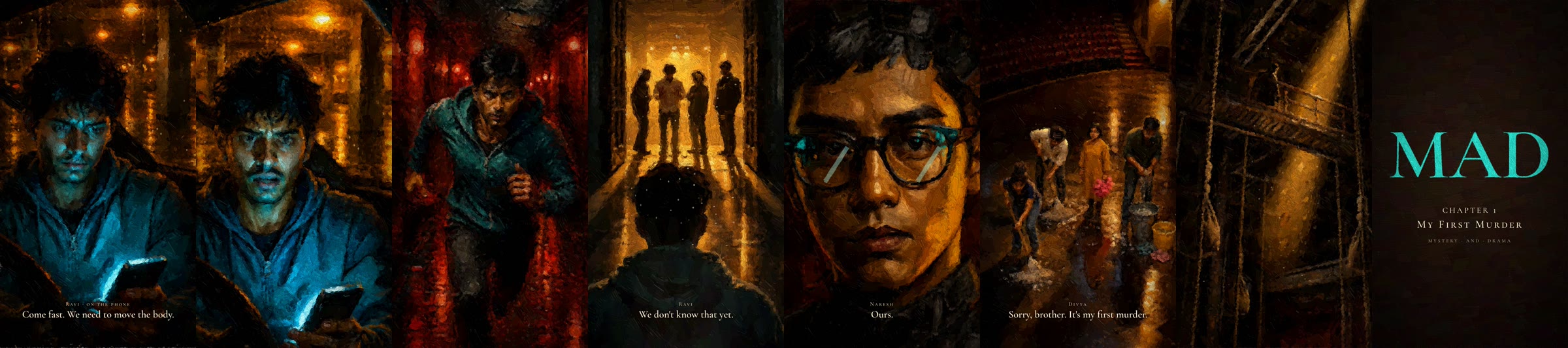
Every frame in this reel was painted by the engine. It opens on the teaser for MAD, shows a painting being laid onto a bare canvas, and walks through how the skill works.
03 / STORY TO FILM
Claude directs. The engine paints.
The skill teaches Claude to work like a small film crew. It asks one round of questions, then makes every other decision itself:
- Shot list. Claude reads the chapter and writes 6–10 shots: framing, camera move, what changes, and the line of dialogue.
- Paintings. One image per shot from whatever generator the user has connected (Canva, Codex, an image API) or their own art, with fixed character descriptions so faces stay consistent.
- film.json. The whole film as data: shots, images, camera paths, light effects, subtitles, title and soundtrack.
- Preview and render. A headless browser paints each frame; ffmpeg adds the soundtrack and exports an MP4 and subtitles.
04 / THE PAINTING ENGINE
Brush strokes that follow the shape of things.
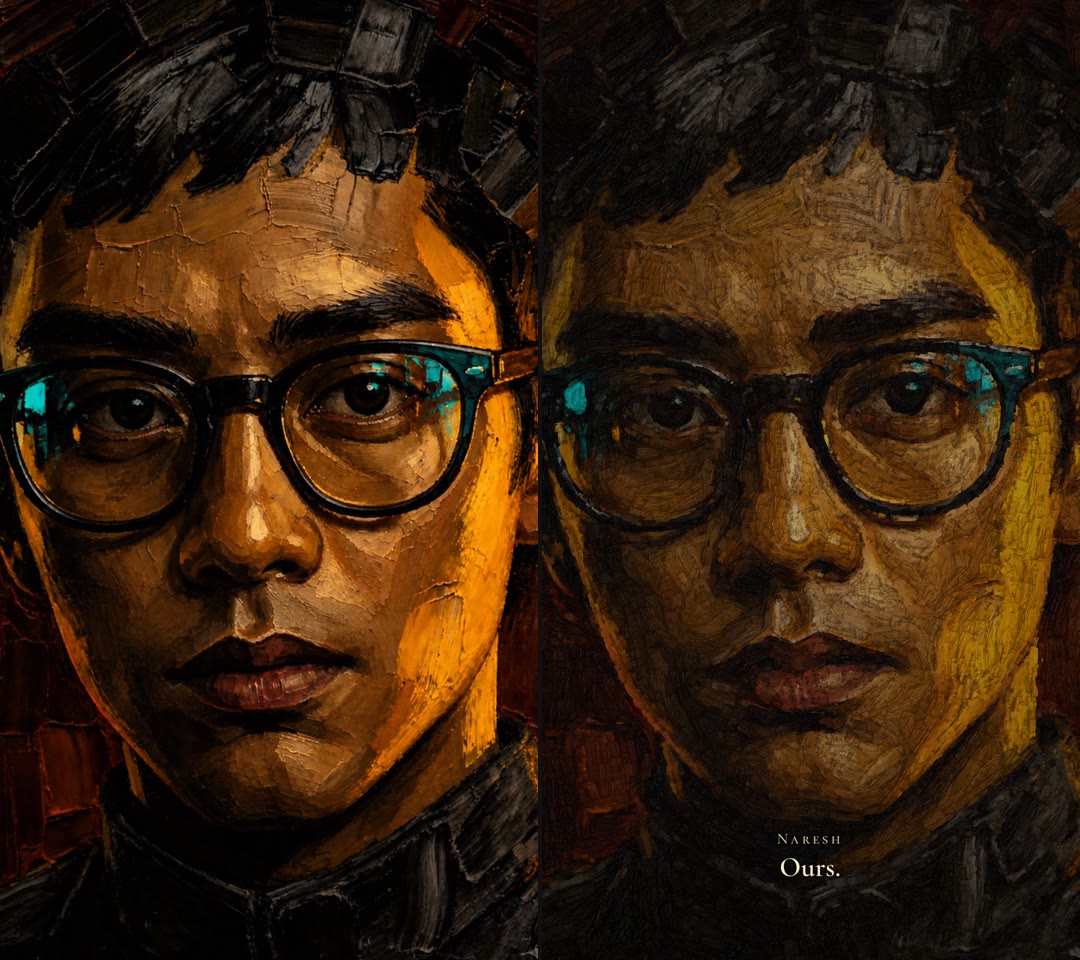
Filters that make a photo “look painted” smear everything the same way. A painter doesn’t: strokes follow the curve of a cheek, the edge of a jaw, the fold of a sleeve. The engine imitates that in three steps:
- Read the image’s flow. A structure-tensor analysis finds which way the forms run at every point, so each stroke is traced along the image instead of laid at random.
- Paint coarse to fine. Broad brushes cover everything first; smaller brushes go only where the image has detail, and a stroke stops where the colour changes so outlines stay crisp.
- Light the paint. Each stroke records how thick its paint is. A GPU pass turns that thickness into relief, with bristle streaks, paint that runs dry at the end of a stroke, and a low raking light that makes the ridges flare.
05 / PAINTINGS THAT ACT
Repainting is the animation.
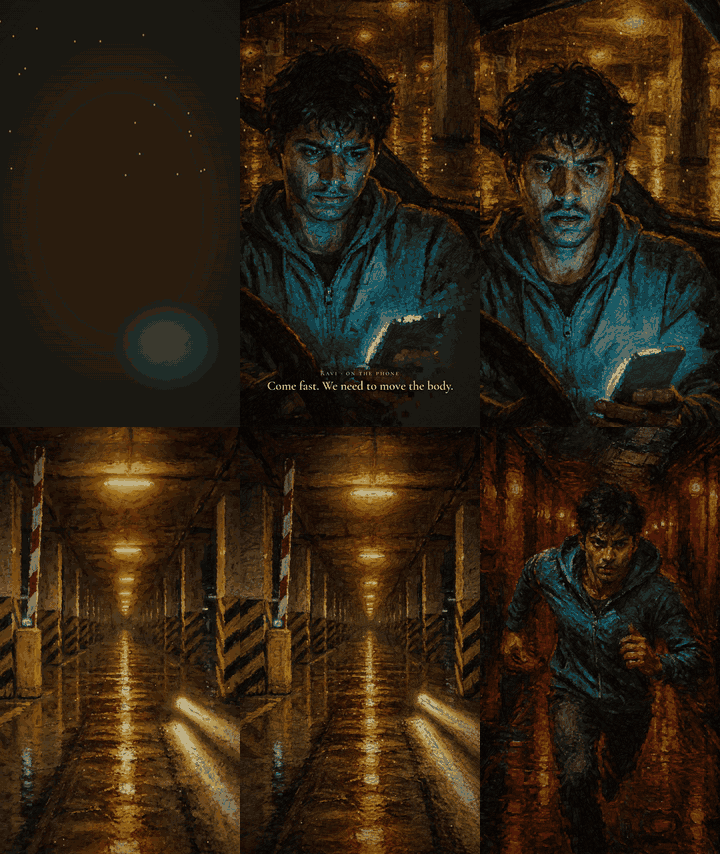
Still paintings don’t move, so the films use the medium itself. For a moment of acting, the character looking up or a barrier rising, Claude generates a second version of the same painting with only that change. The engine then repaints the frame stroke by stroke from one to the other, and the change reads as movement.
On top of that, the camera pushes, pulls and pans inside each painting (never past its edges), and light effects like dust in a beam, a flickering lamp or a glint across glasses are layered in as light, not paint.
06 / WRITING MY OWN ENGINE
Inspired by one project, built from scratch.
The idea grew out of experimenting with Lemo-Opuscar, an open-source library of film styles made in code. I wanted this to be fully my own, so I wrote a new engine with a different design: curved, flow-following brush strokes where that library lays straight knife strokes, a single-layer paint model, and my own lighting and colour grade.
A supervisor for honesty
While building, I ran a separate review agent after every milestone. It checked licences, scanned for leaked personal data, ran the renderer, and compared my code against the original library token by token. Its first check failed my claim of “written from scratch”, so I redesigned the renderer until the claim was true.
07 / HOW IT’S BUILT
A skill, a player and a renderer.
| Part | What it does | Built with |
|---|---|---|
| Skill | Teaches Claude the workflow: brief, shot list, image prompts, variants, film.json | Claude Code skill (SKILL.md + reference guides) |
| Stroke builder | Turns an image into curved strokes that follow its flow field | JavaScript, structure tensor, integral images |
| Painter | Draws brush ribbons with bristles and dry-out, lights the paint as relief | WebGL2 shaders |
| Player | Shots, camera, paint-over acting, light effects, subtitles, title | JavaScript, driven by one film.json |
| Renderer | Previews, resumable frame render, software-GPU mode, MP4 + SRT | Node.js, Playwright, ffmpeg |
08 / TAKEAWAYS
The look comes from the input, not the filter.
My first version drew every scene in code, and no amount of brushwork rescued simple shapes: it looked like clip art with texture. The breakthrough was generating rich paintings first and making the engine’s job repainting them. The second lesson was about honesty: a claim on a README is part of the product, and it is worth checking as carefully as the code.
painted-cinema is free and open source. If you write stories and want to see one painted, or want to help build new styles like watercolour or ink, open an issue or get in touch.