
01 / THE PROBLEM
College teaches code, not companies.
Students learn to program, but almost nobody practises running a team. Who do you hire first? What happens when someone takes leave the week before a demo? How do two engineers settle a disagreement, and who decides when to ship?
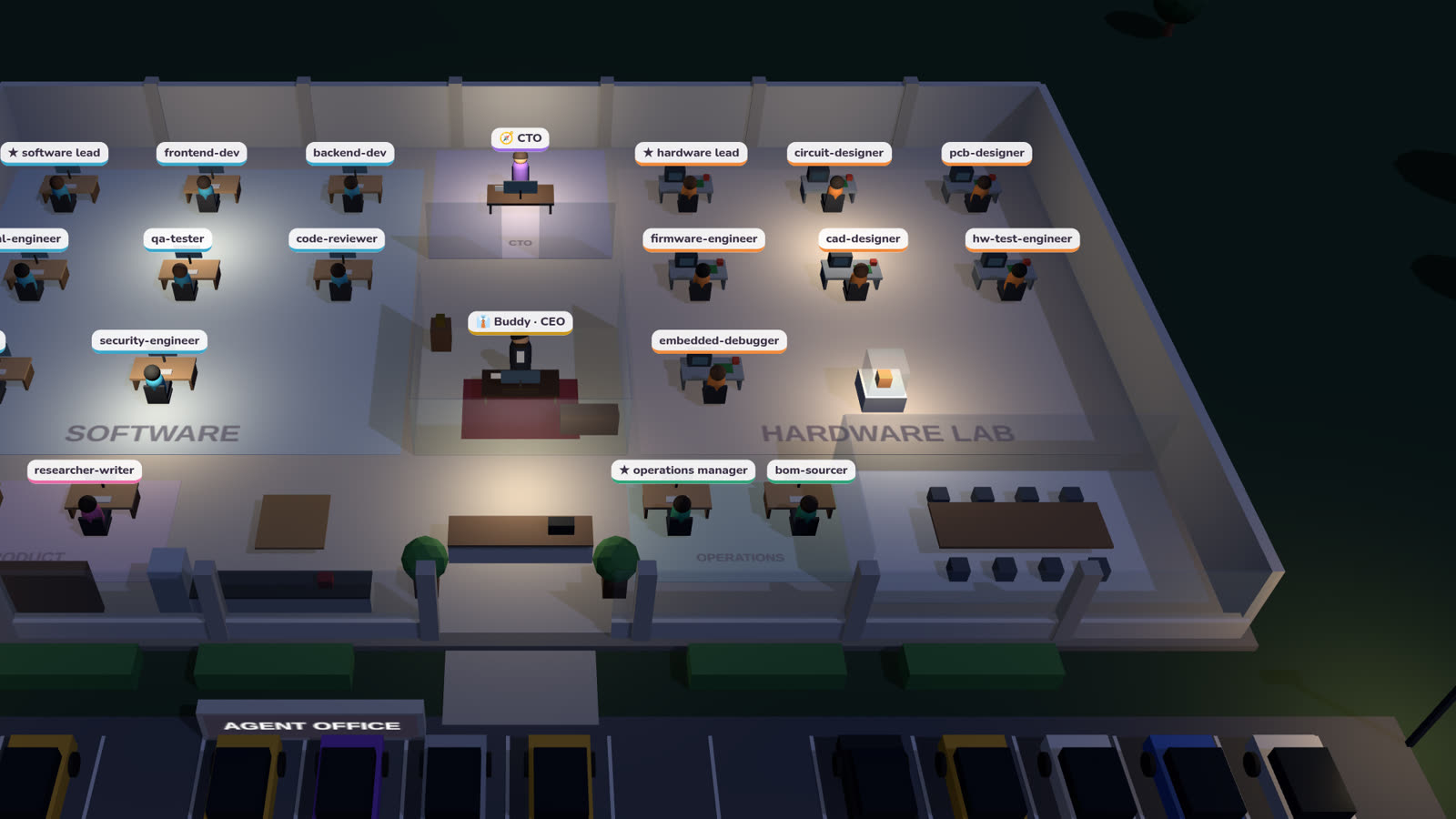
Business-school simulations are spreadsheets. I wanted a place where you could actually run a small company, with teammates who do real work, make real mistakes and need real decisions from you. Agent Office is that place: an AI startup in a 3D office, with Buddy, my desktop assistant, as its CEO.
02 / WATCH A SPRINT
A desk lamp, from brief to approved spec.
In this clip the founder asks for Lumi, a desk lamp that knows when you’re tired. Buddy walks the brief to the CTO, the team holds a kickoff, and a spec review catches that “tired” meant three different things to three people, before anyone builds.
03 / THE ORG CHART
Roles taken from real startups.
My first version had an “Operations Manager” running everything. That isn’t how a real company works, so I redesigned the org around real roles: the person who plans engineering work and runs quality checks is a CTO, team leads split their team’s work, and operations means budget, parts and schedule.
| Team | Roles | What they own |
|---|---|---|
| Leadership | Buddy (CEO), CTO | The vision; the plan, hand-offs and quality checks |
| Software (8) | Architect (lead), frontend, backend, AI/ML, QA, code review, DevOps, security | Apps, services, models, tests and reviews |
| Hardware lab (7) | Architect (lead), circuits, PCB, firmware, CAD, test, embedded debug | Schematics, boards, firmware, enclosures, bring-up |
| Product & research (2) | Product manager, researcher-writer | Specs with acceptance criteria, research and docs |
| Operations (2) | Operations manager, parts sourcer | Budget in ₹, purchase plan, lead times, schedule |
04 / SPEC BEFORE BUILD
Nobody builds until the founder approves the spec.
My first demo had the CTO handing out tasks straight away, and the team discovering they’d misunderstood each other two days later. That is a lesson worth teaching, but not a process worth copying. The CTO now runs the flow a good startup would:
- Kickoff. The goal, the users, the deadline and the budget, agreed with product, both team leads and operations.
- Spec. The product manager writes a one-page spec with clear “done when” checks. The leads and operations review it for gaps.
- Founder approval. The CTO stops and asks “Approve the spec?”. No building work goes out until the founder says yes.
- Leads plan, CTO delegates. Each lead splits their team’s work into tasks with an owner, an output file and a done-when; the CTO sends one brief per task.
- Build, review, test. Code goes through review and QA, hardware gets a test plan, and each lead signs off that their team’s pieces fit together.
05 / REAL WORK, NOT ROLE-PLAY
The agents use the tools engineers use.
Each agent is a Claude sub-agent with its own role, instructions and tool permissions. They write real files into the project folder, and they check their work instead of guessing:
- Firmware is compiled with arduino-cli and PlatformIO before it is reported as done.
- Circuits are simulated with ngspice; boards are checked and exported with KiCad.
- Enclosures are modelled in OpenSCAD and sliced with PrusaSlicer to get a real print time.
- Parts lists come with prices in rupees and Indian suppliers.
- Your own idea can come in as PDFs, images or notes, dropped onto the office; each project gets its own folder.
06 / THE HUMAN STAYS IN CHARGE
Agents do the work. People approve the risk.
Reading, searching and editing inside the project folder run freely. Anything that could cause harm stops and asks: flashing a board, installing packages, pushing code, deleting files, or spending money. The founder approves from the 3D office, from the terminal, or by voice through Buddy, and every action lands in an execution log.
Why the office is 3D
A log of agent messages is hard to follow. In the office you can see who is working, who is waiting for you, and where work is piling up. Envelopes fly between desks on every hand-off, and stress bars rise in a crunch. The picture explains the process faster than the text.
07 / WHERE IT’S GOING
An open-source startup playground.
The office engine works today. Next, I’m turning it into a playground for students and first-time founders:
- Pick a project or bring your own. A library of real startup problems, or your own idea and documents.
- Build your team. Hire roles, let people go, reorganise teams, and live with the consequences.
- Mix humans and AI. Sit in any seat yourself, with AI teammates who work around you and wait on your output.
- Real company life. Leave requests, stress, promotion requests and tight deadlines, each one forcing a decision.
- Find your role. Every decision is logged, so you can look back and see which role really suits you.
- Low shared cost. The large model does only the real work; cheap rules run the drama, so any student can play.
08 / HOW IT’S BUILT
One orchestrator, many specialists.
| Part | What it does | Built with |
|---|---|---|
| Office runner | Runs the CTO session, hands work to sub-agents, keeps going until nobody is busy | Claude Agent SDK, Python asyncio |
| Roster | Each role’s team, job, tools and working style | Agent definitions with per-role tool lists |
| Approvals | Lets safe actions run, asks before risky ones | Permission callback + allow-list of safe commands |
| State | Who is working on what, and every event | Hooks writing a JSON board and an event log |
| 3D office | Desks, people, hand-offs, approvals, uploads, the demo story | three.js, a small built-in web server |
| Voice front door | Assign goals, check status and approve by voice | Desktop Buddy tools over the office’s local API |
The demo video is generated too: a script records the office’s story mode in a background browser, Buddy’s voice reads a narration timed to each chapter, and ffmpeg puts the pieces together.
09 / TAKEAWAYS
Model the process before the agents.
The agents were the easy part. The hard part was the organisation around them: which role owns which decision, when work must stop for a human, and in what order things happen. Getting the org chart and the spec-first flow right made the agents more useful than any prompt change did.
Agent Office is open source and in active development. The repository has the office runner, the roles, the 3D office and the scripts that made the demo video. If you’re a student or builder who wants to help shape it, open an issue or get in touch.